The Return
539–430 BC · Daniel 5–12, Ezra, Nehemiah, Haggai, Zechariah, Esther, Obadiah, Malachi, Psalms Book V
Narration in Mandarin Chinese · English version in production
God's promise is greater than Persia
- Person
- Malachi
- Key verse
- Behold, I send my messenger, and he will prepare the way before me. And the Lord whom you seek will suddenly come to his temple; and the messenger of the covenant in whom you delight, behold, he is coming, says the LORD of hosts.Mal 3:1
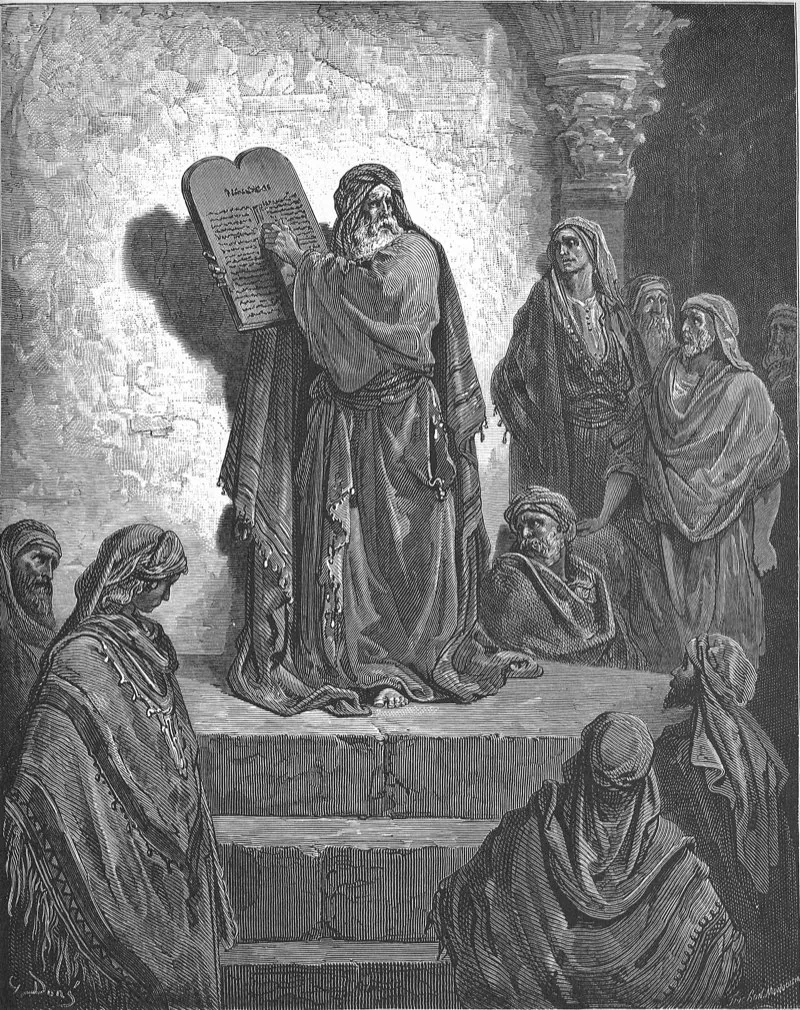
- The Temple Rebuilt
Zerubbabel led more than 40,000 people home; they laid the foundation, then the work stopped for 16 years. Haggai and Zechariah stirred the people up, and the second temple was completed in 516 BC. Zechariah foretold the humble king riding on a donkey, the thirty pieces of silver, and the one who was pierced.Ezra 1-6HagZech
- Esther
The Jews who stayed in Persia were nearly wiped out by Haman. “And who knows whether you have not come to the kingdom for such a time as this?” The book never names God, yet his hand is seen everywhere.Esth 1-10
- Malachi and the 400 Silent Years
Worship had become a matter of going through the motions. Malachi foretold, “Behold, I send my messenger, and he will prepare the way before me,” and that Elijah would come. Then for 400 years there was no prophet, until John the Baptist.Mal 1-4
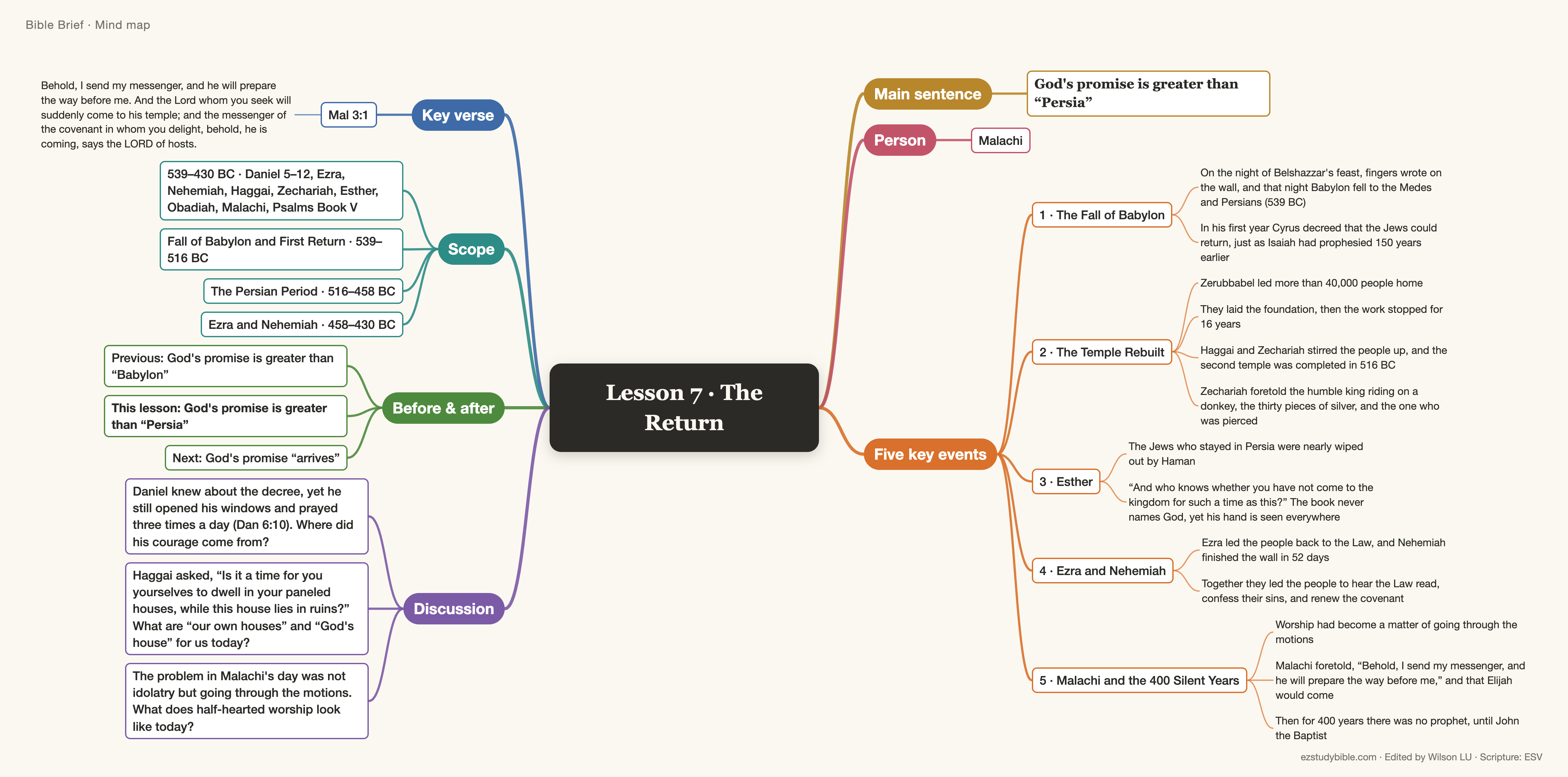
- Lesson 7: God's promise is greater than Persia
- This lesson's person is Malachi
- Behold, I send my messenger, and he will prepare the way before me
Think first, then tap a blank to see the answer.
Group discussion
- Daniel knew about the decree, yet he still opened his windows and prayed three times a day (Dan 6:10). Where did his courage come from?
- Haggai asked, “Is it a time for you yourselves to dwell in your paneled houses, while this house lies in ruins?” What are “our own houses” and “God's house” for us today?
- The problem in Malachi's day was not idolatry but going through the motions. What does half-hearted worship look like today?
Reference notes for the discussion questions (church leaders)
…
Look up all points and notes 19 points
Fall of Babylon and First Return
- 165
Daniel 5–9Belshazzar held a feast and drank from the temple vessels, and fingers wrote on the wall. Daniel read it: that very night Babylon fell to the Medes and Persians. Daniel kept praying as before and was thrown into the lions' den, and God shut the lions' mouths. The vision of four beasts: after four kingdoms, “one like a son of man” receives dominion and an everlasting kingdom. The ram (Medo-Persia) is broken by the goat (Greece). Reading Jeremiah's prophecy of seventy years, Daniel prays and confesses sin, and Gabriel tells him of “seventy weeks”: from the word to rebuild Jerusalem until an anointed one, a prince, comes; then the anointed one is cut off, and the city and the sanctuary are destroyed.Dan 5-9
- 166
- 167
Daniel 10–12By the Tigris Daniel saw a man clothed in linen; the archangel Michael helped him against the princes of Persia and Greece. After Persia a mighty king of Greece will arise, and his kingdom will be divided into four. The king of the south and the king of the north will war year after year with Judah caught between them, and one king will profane the sanctuary and set up the abomination that makes desolate. At the end Michael will arise, and many who sleep in the dust will awake, some to everlasting life and some to shame.Dan 10-12
- 168
After about 16 years at a standstill, in the second year of Darius (520 BC), stirred up by Haggai and Zechariah, the people resumed rebuilding the temple.Ezra 5-6
The original Brief says the work stopped for 15 years; from 536 to 520 BC is about 16 years. - 169
Haggai“Is it a time for you yourselves to dwell in your paneled houses, while this house lies in ruins?” Go up to the hills, bring wood, and build the house. The latter glory of this house will be greater than the former.Hag 1-2
- 170
Zechariah 1“Return to me … and I will return to you.” Do not be like your fathers.Zech 1
- 171
Haggai 2God will shake the heavens, the earth, and all nations, and he will keep Zerubbabel and make him like a signet ring.Hag 2
- 172
Zechariah 1–14Eight night visions: the horsemen, four horns and four craftsmen, the measuring line, the high priest Joshua's filthy garments exchanged, the golden lampstand and two olive trees, the flying scroll, the woman in the basket, and the four chariots. The prophet foretells “the Branch” of David, who will build the temple as both priest and king. “Rejoice greatly, O daughter of Zion! … Behold, your king is coming to you; righteous and having salvation is he, humble and mounted on a donkey.” The shepherd's wages are thirty pieces of silver. “They look on me, on him whom they have pierced.” “Strike the shepherd, and the sheep will be scattered.” The LORD's feet will stand on the Mount of Olives, and the mountain will split in two. All nations will go up to Jerusalem to keep the Feast of Booths, and there will be no more traders in the house of the LORD.Zech 1-14
- 173
The second temple was completed (516 BC), exactly 70 years after the first temple was destroyed.Ezra 6
The Persian Period
- 174
ObadiahEdom stood aloof on the day of Jerusalem's calamity and even cut down those who escaped. Edom will be repaid, and exiled Israel will possess its land again, “and the kingdom shall be the LORD's.”Obad 1
The original Brief places Obadiah in the Persian period. Most scholars date it shortly after the fall of Jerusalem in 586 BC. - 175
In the reign of Ahasuerus (Xerxes) the Samaritans wrote an accusation against the Jews.Ezra 4
The original cites “Daniel 11” here, which has nothing to do with this event; the reference has been removed. - 176
EstherKing Ahasuerus deposed Queen Vashti and made Esther, a Jewish woman, his queen. Haman the Amalekite rose to power and plotted to destroy every Jew in the empire. Mordecai said to Esther, “And who knows whether you have not come to the kingdom for such a time as this?” Esther risked her life to go before the king and exposed Haman. The king let the Jews defend themselves, and they killed 75,000 of their enemies. The Jews established the feast of Purim to remember it. The book never names God, yet his hand is seen everywhere.Esth 1-10
Ezra and Nehemiah
- 177
In the seventh year of Artaxerxes (458 BC), Ezra the scribe led about 1,500 people home. When he found that the people had intermarried with the peoples of the land, he tore his garments and prayed, and the people made a covenant to put away their foreign wives. Their enemies petitioned the king, and the rebuilding of the wall was stopped.Ezra 4Ezra 7-10
- 178
In the twentieth year of Artaxerxes (445 BC), Nehemiah the cupbearer heard that Jerusalem's wall lay broken down. He fasted and prayed, and asked the king to send him back. He inspected the wall by night and led the people to finish it in 52 days, each working with one hand and holding a weapon with the other.Neh 1-6
- 179
Ezra read the Law before the Water Gate; the people wept, and then they kept the Feast of Booths. All the people confessed their sins and made a covenant to keep the Law: no intermarriage with the peoples of the land, keeping the Sabbath, and supporting the temple.Neh 7-13
- 180
Psalms Book V (107–150)Includes Ps 110, “The LORD says to my Lord: ‘Sit at my right hand’”; Ps 118, “The stone that the builders rejected has become the cornerstone”; Ps 119, the song of the Law; the Songs of Ascents, Ps 120–134; and Ps 137, “By the waters of Babylon, there we sat down.” The last five psalms each end with “Hallelujah” (Praise the LORD).Ps 107-150
- 181
Nehemiah went back to Persia to report to the king. While he was away, the high priest gave Tobiah the Ammonite a room in the temple, the people stopped bringing their tithes, and they traded on the Sabbath.Neh 13
- 182
MalachiThe last book of the Old Testament. The priests offer lame and sick animals: “Oh that there were one among you who would shut the doors.” The LORD hates divorce. “Bring the full tithe into the storehouse … if I will not open the windows of heaven for you.” “Behold, I send my messenger, and he will prepare the way before me … the sun of righteousness shall rise.” “Behold, I will send you Elijah the prophet before the great and awesome day of the LORD comes.” Then come 400 years of silence.Mal 1-4Matt 11Matt 17
- 183
Nehemiah returned to Jerusalem a second time. He threw Tobiah out, restored the tithes and the Sabbath, and rebuked those who had intermarried.Neh 13