Exile in Babylon
609–539 BC · 2 Kings 23–25, 2 Chronicles 36, Habakkuk, Jeremiah, Lamentations, Ezekiel, Daniel 1–4
Narration in Mandarin Chinese · English version in production
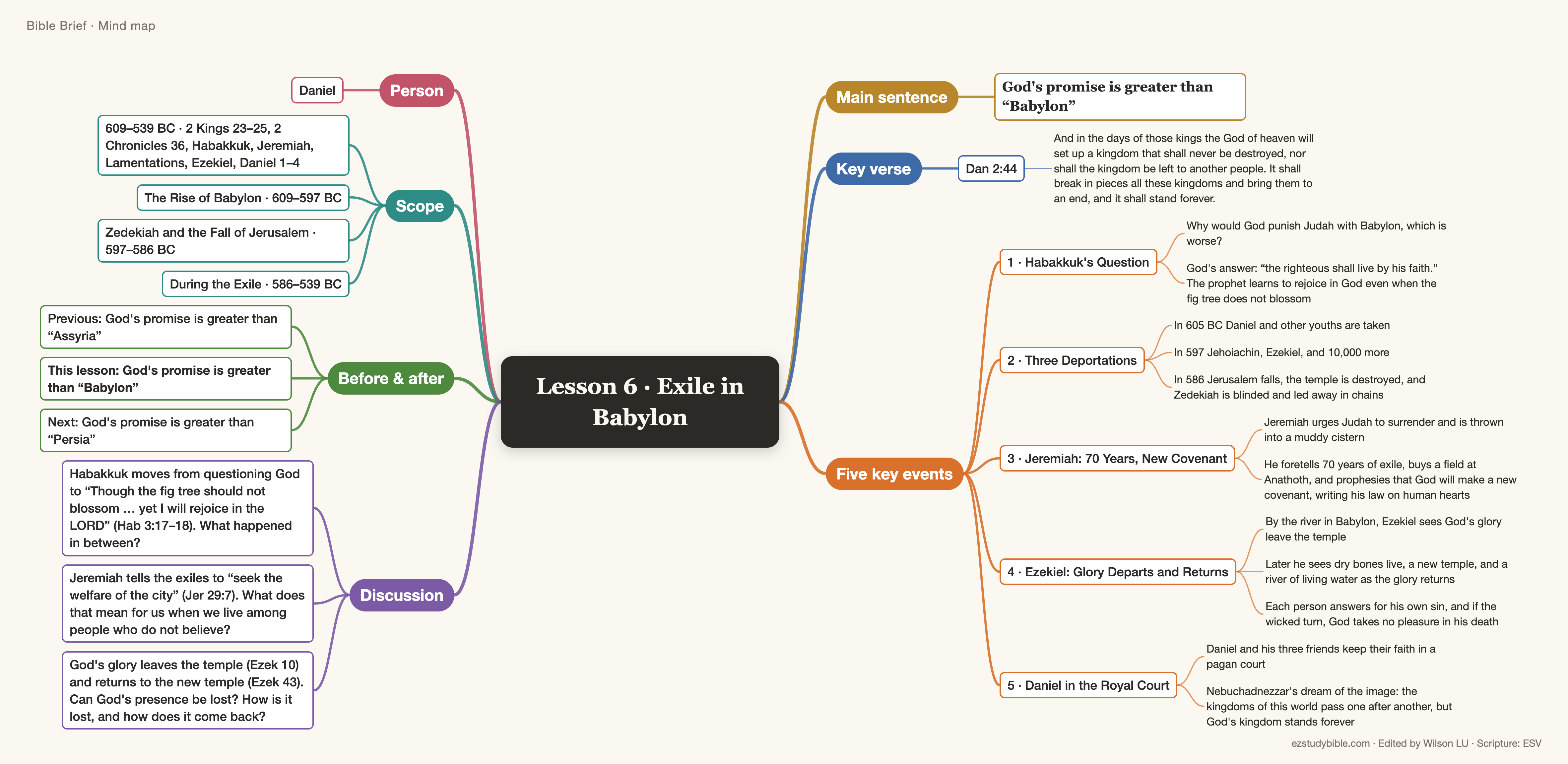
God's promise is greater than Babylon
- Person
- Daniel
- Key verse
- And in the days of those kings the God of heaven will set up a kingdom that shall never be destroyed, nor shall the kingdom be left to another people. It shall break in pieces all these kingdoms and bring them to an end, and it shall stand forever.Dan 2:44
- Habakkuk's Question
Why would God punish Judah with Babylon, which is worse? God's answer: “the righteous shall live by his faith.” The prophet learns to rejoice in God even when the fig tree does not blossom.Hab 1-3
- Three Deportations
In 605 BC Daniel and other youths are taken; in 597 Jehoiachin, Ezekiel, and 10,000 more; in 586 Jerusalem falls, the temple is destroyed, and Zedekiah is blinded and led away in chains.2 Kgs 24-252 Chr 36
- Ezekiel: Glory Departs and Returns
By the river in Babylon, Ezekiel sees God's glory leave the temple. Later he sees dry bones live, a new temple, and a river of living water as the glory returns. Each person answers for his own sin, and if the wicked turn, God takes no pleasure in his death.Ezek 1-11Ezek 33-48
- Daniel in the Royal Court
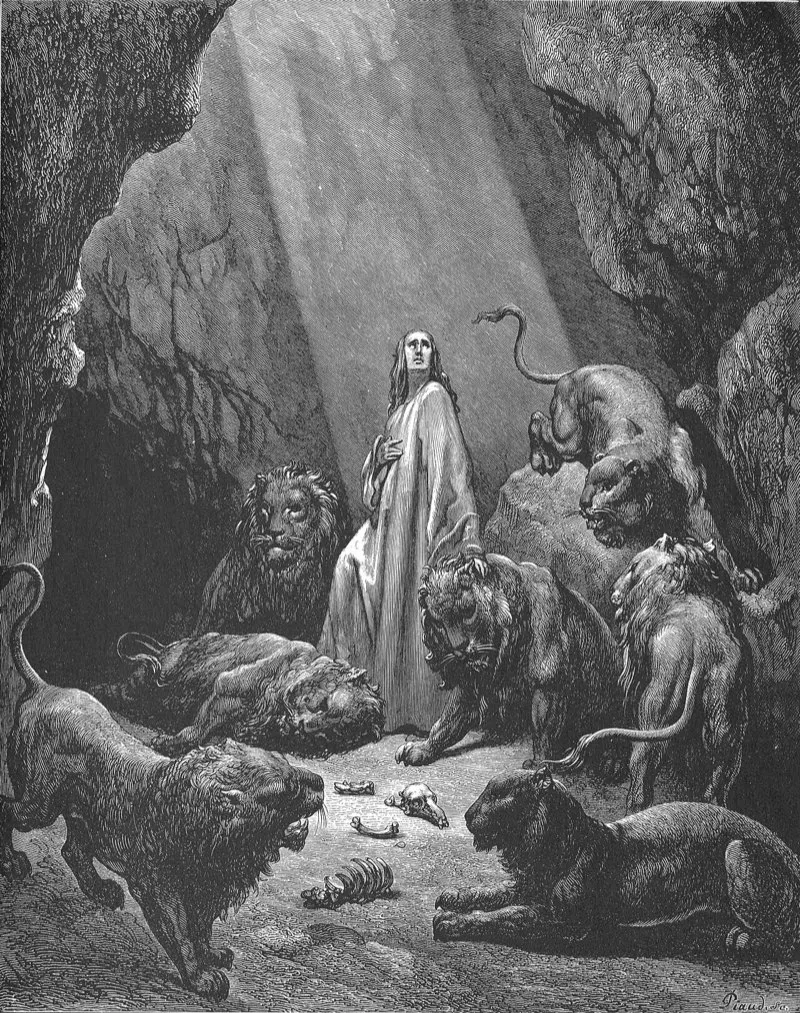
Daniel and his three friends keep their faith in a pagan court. Nebuchadnezzar's dream of the image: the kingdoms of this world pass one after another, but God's kingdom stands forever.Dan 1-4
- Lesson 6: God's promise is greater than Babylon
- This lesson's person is Daniel
- God told Habakkuk: the righteous shall live by his faith
Think first, then tap a blank to see the answer.
Group discussion
- Habakkuk moves from questioning God to “Though the fig tree should not blossom … yet I will rejoice in the LORD” (Hab 3:17–18). What happened in between?
- Jeremiah tells the exiles to “seek the welfare of the city” (Jer 29:7). What does that mean for us when we live among people who do not believe?
- God's glory leaves the temple (Ezek 10) and returns to the new temple (Ezek 43). Can God's presence be lost? How is it lost, and how does it come back?
Reference notes for the discussion questions (church leaders)
…
Look up all points and notes 20 points
The Rise of Babylon
- 144
HabakkukHabakkuk asks God why he tolerates Judah's sin. God answers that he will punish Judah with the Chaldeans, who are worse still. Habakkuk asks again, and God says, “the righteous shall live by his faith.” In the end the prophet rejoices in the God of his salvation even when the fig tree does not blossom.Hab 1-3Rom 1
- 145
- 146
Daniel 1–3Daniel and his three friends refuse to defile themselves with the king's food. God shows Daniel Nebuchadnezzar's dream: the image's head of gold is Babylon, other kingdoms follow, and at last a stone “cut out by no human hand” shatters the image, and God's kingdom stands forever. Daniel is made ruler over the province of Babylon. His three friends refuse to worship the golden image and are thrown into the fiery furnace, where one “like a son of the gods” is with them in the fire.Dan 1-3
- 147
Jeremiah 25, 35–36, 45Jeremiah prophesies that Judah will serve the king of Babylon 70 years, and then Babylon will be punished. Jehoiakim cuts up Jeremiah's scroll column by column and burns it; Jeremiah writes another. The Rechabites keep their forefather's command not to drink wine, a contrast to Judah, which will not listen to God.Jer 25Jer 35-36Jer 45
- 148
- 149
Jeremiah 7–16The temple sermon: “Do not trust in these deceptive words: ‘This is the temple of the LORD, the temple of the LORD, the temple of the LORD’”; the temple will be destroyed like Shiloh. The burning of children in the Valley of the Son of Hinnom will be repaid. The false prophets cry “Peace, peace.” God forbids Jeremiah to marry, as a sign of judgment.Jer 7-16
- 150–151
Zedekiah and the Fall of Jerusalem
- 152
Jeremiah 27–31, 51Jeremiah wears a yoke to urge the nations to serve Babylon. The false prophet Hananiah breaks the yoke and dies that same year. Jeremiah writes to the exiles: seek the welfare of the city; after 70 years you will return. “I will make a new covenant with the house of Israel … I will put my law within them, and I will write it on their hearts.” A righteous Branch will rise from David's house. Rachel weeps for her children (quoted in Matt 2 at Bethlehem). Babylon will fall.Jer 27-31Jer 51Heb 8
- 153
Ezekiel 1–24By the Chebar canal Ezekiel sees four living creatures, wheels within wheels, and above them the glory of the LORD. He lies on his side 390 days and then 40, bearing the sin of Israel and Judah, and acts out the siege with signs such as his hair and a brick. He sees God's glory leave the temple and rest on the Mount of Olives. Each person answers for his own sin; if the wicked turn, God takes no pleasure in his death. Oholah (Samaria) lusts after Assyria, Oholibah (Jerusalem) after Babylon. Ezekiel's wife dies and he may not mourn, as a sign for Jerusalem.Ezek 1-24
The original Brief takes the lioness of Ezek 19 as Hamutal, Josiah's queen. This is a common interpretation, but the text does not name her. - 154
Zedekiah rebels against Babylon and relies on Egypt.2 Kgs 24-252 Chr 36Ezek 17
- 155
Jeremiah 17–24, 32–34, 37–39The potter and the clay: the LORD may do with Israel as he pleases. Jeremiah breaks a clay flask in the Valley of the Son of Hinnom, foretelling that Jerusalem will become like Topheth. Two baskets of figs: the good are the exiles, who will return; the bad are Zedekiah's party, who will perish. “I will raise up for David a righteous Branch … this is the name by which he will be called: ‘The LORD is our righteousness.’” During the siege Jeremiah buys a field at Anathoth as proof that “Houses and fields … shall again be bought in this land.” Jeremiah is thrown into the muddy cistern of Malchiah, and Ebed-melech the Ethiopian pulls him out. He urges Zedekiah to surrender so the city will not be burned.Jer 17-24Jer 32-34Jer 37-39
The original Brief says Jeremiah was held in “Asa's cistern.” Jer 38:6 names the cistern of Malchiah, the king's son; the cistern King Asa made (Jer 41:9) is where Ishmael threw the bodies and has nothing to do with Jeremiah. - 156
Ezekiel 29Egypt will lie desolate 40 years. Though restored afterward, it will be a lowly kingdom and never again rule over the nations.Ezek 29
- 157
- 158
Ezekiel 26–28, 31Tyre will become a bare rock, a place for spreading nets; the king of Tyre, who claims to be a god, will be cast out. Sidon will suffer pestilence. Assyria has fallen like a cedar of Lebanon, and so will Egypt.Ezek 26-28Ezek 31
- 159
During the Exile
- 160
Jeremiah 46–49Oracles against Egypt, Philistia, Moab, Ammon, Edom, Damascus, Kedar, and Elam. Those who flee to Egypt will perish; those exiled to Babylon will find peace. The LORD will set his throne in Elam.Jer 46-49
- 161
LamentationsFive acrostic laments weep over Zion's desolation: “How lonely sits the city that was full of people!” Yet in the depths there is hope: “The steadfast love of the LORD never ceases; his mercies never come to an end; they are new every morning.”Lam 1-5
- 162
Ezekiel 32–48The watchman's duty. The dry bones live: “I will put my Spirit within you, and you shall live”; Israel and Judah become one nation, with David as their shepherd and king. Gog leads the nations against Israel and is defeated by the LORD. The vision of the new temple: God's glory returns, living water flows from the threshold, makes the Dead Sea fresh, and trees line both banks. The twelve tribes receive their land again, and the city's name will be “The LORD Is There.”Ezek 32-48Rev 22
- 163
Daniel 4Nebuchadnezzar dreams of a great tree cut down. Daniel interprets: the king will be driven out to live with the beasts for “seven periods of time,” until he knows that the Most High rules the kingdom of men. When he is restored, the king praises the King of heaven.Dan 4
- 164