Paul's Journeys
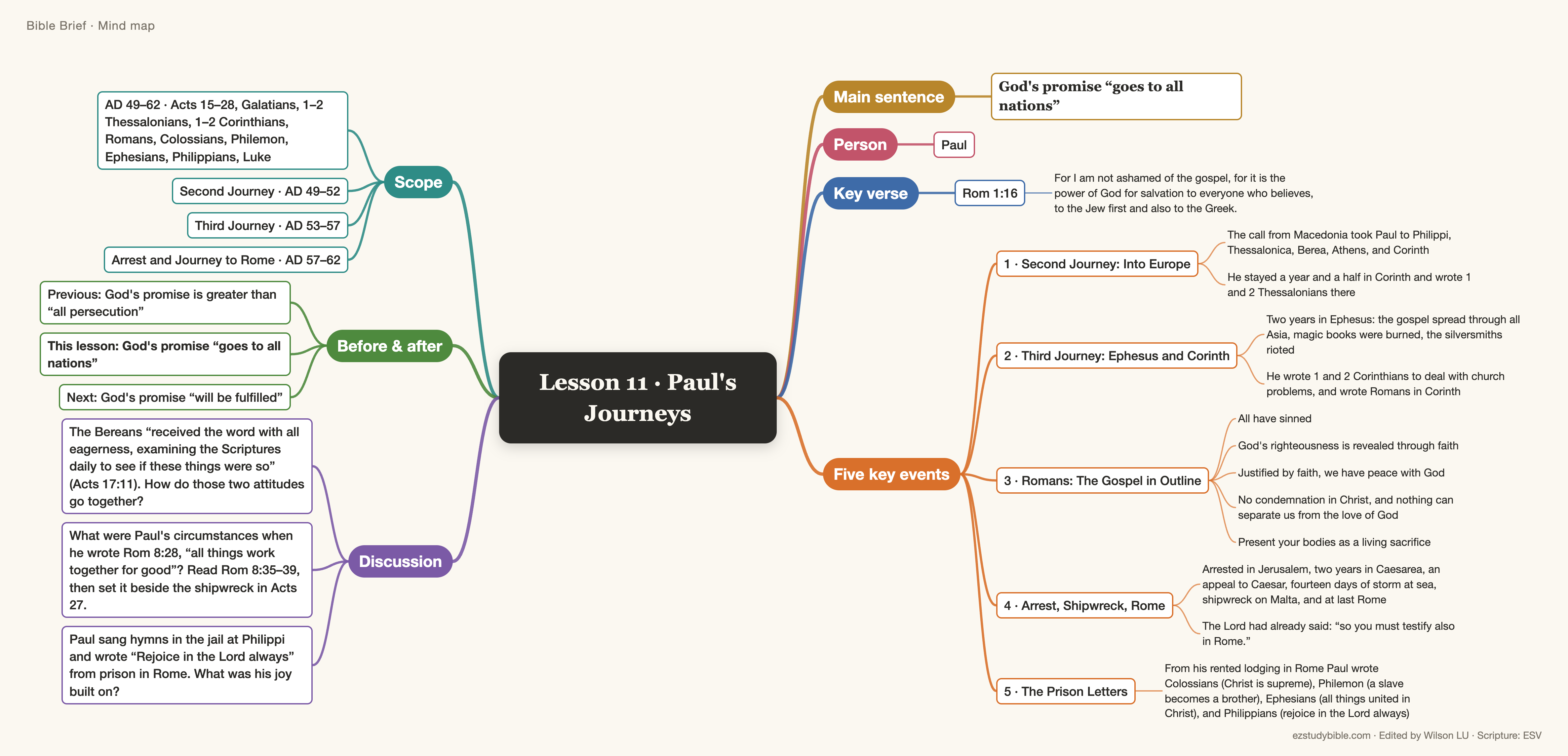
AD 49–62 · Acts 15–28, Galatians, 1–2 Thessalonians, 1–2 Corinthians, Romans, Colossians, Philemon, Ephesians, Philippians, Luke
Narration in Mandarin Chinese · English version in production
God's promise goes to all nations
- Person
- Paul
- Key verse
- For I am not ashamed of the gospel, for it is the power of God for salvation to everyone who believes, to the Jew first and also to the Greek.Rom 1:16
- Second Journey: Into Europe
The call from Macedonia took Paul to Philippi, Thessalonica, Berea, Athens, and Corinth. He stayed a year and a half in Corinth and wrote 1 and 2 Thessalonians there.Acts 16-181 Thess2 Thess
- Third Journey: Ephesus and Corinth
Two years in Ephesus: the gospel spread through all Asia, magic books were burned, the silversmiths rioted. He wrote 1 and 2 Corinthians to deal with church problems, and wrote Romans in Corinth.Acts 19-201 Cor2 Cor
- Romans: The Gospel in Outline
All have sinned; God's righteousness is revealed through faith; justified by faith, we have peace with God; no condemnation in Christ, and nothing can separate us from the love of God; present your bodies as a living sacrifice.Rom 1-16
- Arrest, Shipwreck, Rome
Arrested in Jerusalem, two years in Caesarea, an appeal to Caesar, fourteen days of storm at sea, shipwreck on Malta, and at last Rome. The Lord had already said: “so you must testify also in Rome.”Acts 21-28
- The Prison Letters
From his rented lodging in Rome Paul wrote Colossians (Christ is supreme), Philemon (a slave becomes a brother), Ephesians (all things united in Christ), and Philippians (rejoice in the Lord always).ColPhlmEphPhil
- Lesson 11: God's promise goes to all nations
- This lesson's person is Paul
- I am not ashamed of the gospel, for it is the power of God
Think first, then tap a blank to see the answer.
Group discussion
- The Bereans “received the word with all eagerness, examining the Scriptures daily to see if these things were so” (Acts 17:11). How do those two attitudes go together?
- What were Paul's circumstances when he wrote Rom 8:28, “all things work together for good”? Read Rom 8:35–39, then set it beside the shipwreck in Acts 27.
- Paul sang hymns in the jail at Philippi and wrote “Rejoice in the Lord always” from prison in Rome. What was his joy built on?
Reference notes for the discussion questions (church leaders)
…
Look up all points and notes 33 points
Second Journey
- 281
Galatians“But even if we or an angel from heaven should preach to you a gospel contrary to the one we preached to you, let him be accursed.” Paul's gospel came by revelation from Jesus Christ. At Antioch, when Peter drew back for fear of the circumcision party, Paul opposed him to his face. A person is justified not by works of the law but by faith in Jesus Christ. The Law was our guardian to lead us to Christ. “For freedom Christ has set us free.” Walk by the Spirit, and you will not gratify the desires of the flesh.Gal 1-6
The original Brief dates Galatians to AD 48–49 (the South Galatian view, before the Jerusalem Council). Another mainstream view places it during the third journey (c. AD 55). - 282
Barnabas wanted to take Mark; Paul refused, and the two parted. Barnabas took Mark to Cyprus; Paul took Silas overland to strengthen the churches founded on the first journey and deliver the Jerusalem Council's decision. At Lystra Timothy joined them, and Paul circumcised him so as not to offend the Jews. The Spirit did not allow them to go into Asia or Bithynia. At Troas Paul saw a vision in the night of a man of Macedonia calling for help, and Luke joined them here (the “we” passages begin).Acts 15-16
- 283
Philippi: Lydia, a seller of purple goods, was baptized with her household. Paul cast a spirit of divination out of a slave girl and was beaten and jailed. At midnight they prayed and sang hymns; a great earthquake threw every door open. The jailer asked, “What must I do to be saved?” Paul answered, “Believe in the Lord Jesus, and you will be saved, you and your household.”Acts 16Phil 4
- 284
- 285
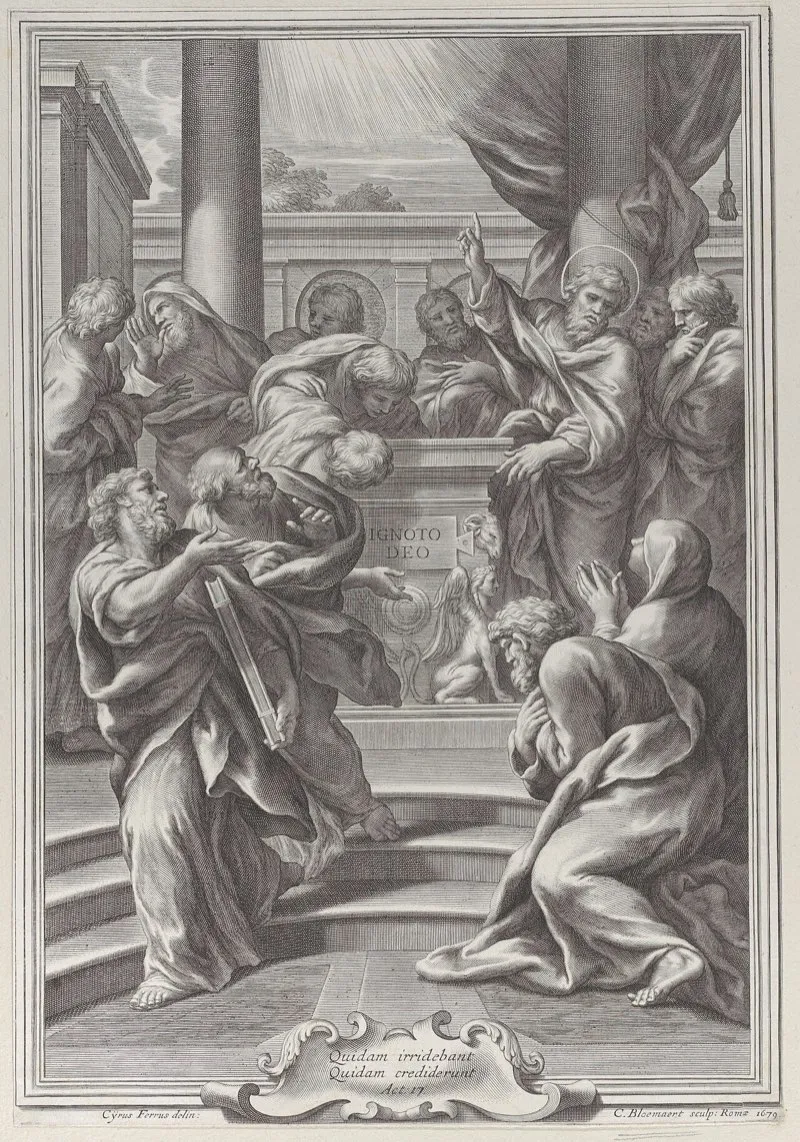
Athens: at the Areopagus Paul told the philosophers that the “unknown god” is the God who made all things, in whom “we live and move and have our being.” He has fixed a day on which he will judge the world by a man he has appointed, and he has given proof to all by raising him from the dead.Acts 17
- 286
- 287
1 ThessaloniansOne of Paul's earliest letters. They received his message “not as the word of men but as what it really is, the word of God.” Those who have fallen asleep will rise first; the living will be caught up with them in the clouds to meet the Lord in the air, and so be with the Lord forever. The day of the Lord will come like a thief in the night. “Rejoice always, pray without ceasing, give thanks in all circumstances.” Do not quench the Spirit.1 Thess 1-5
- 288
The Jews dragged Paul before the proconsul Gallio, who refused to hear the case.Acts 18
- 289
2 ThessaloniansSome were saying the day of the Lord had already come. Paul says that before that day the rebellion must come, and the man of lawlessness, the son of destruction, be revealed; he will take his seat in the temple of God, proclaiming himself to be God. Something now restrains him; when the restrainer is removed, the Lord Jesus will kill him with the breath of his mouth. If anyone is not willing to work, let him not eat.2 Thess 1-3
- 290
Paul sailed from Cenchreae, left Aquila and Priscilla at Ephesus, and returned by way of Caesarea and Jerusalem to Antioch.Acts 18
- 291
Apollos of Alexandria taught about Jesus fervently in Ephesus, though he knew only the baptism of John. Aquila and Priscilla explained the way of God to him more accurately. He later went to Corinth, where he powerfully refuted the Jews.Acts 18
Third Journey
- 292
Paul returned to Ephesus and found twelve disciples who had received only John's baptism. He laid hands on them, the Holy Spirit came on them, and they spoke in tongues. For two years he reasoned daily in the hall of Tyrannus, so that all who lived in Asia heard the word of the Lord.Acts 18-19
- 293
God did extraordinary miracles by the hands of Paul. The seven sons of Sceva, a Jewish high priest, tried to cast out demons on their own and were overpowered by one. Many who had practiced magic brought their books and burned them publicly, worth fifty thousand pieces of silver.Acts 19
- 294
While at Ephesus, Paul made a brief trip to Corinth to deal with problems there (the “painful visit”) and then wrote a severe letter.2 Cor 22 Cor 12-13
The original cites “2 Cor 13, 16”; 2 Corinthians has only 13 chapters. The “painful visit” is inferred from 2 Cor 2:1 and 13:1–2; Acts 19 does not record it. - 295
1 CorinthiansFactions in the church: “I follow Paul,” “I follow Apollos.” The word of the cross is folly to those who are perishing, but to those being saved it is the power of God. Deliver to Satan the man living with his father's wife. Lawsuits between brothers are already a defeat. Your body is a temple of the Holy Spirit. On marriage and singleness. Food offered to idols: knowledge puffs up, but love builds up. No divisions at the Lord's Supper. Spiritual gifts: one body, many members; “If I speak in the tongues of men and of angels, but have not love, I am a noisy gong or a clanging cymbal.” The resurrection: “if Christ has not been raised … your faith is in vain”; at the last trumpet the dead will be raised imperishable.1 Cor 1-16
- 296
Demetrius the silversmith, losing business at the temple of Artemis, stirred the whole city into a riot; the crowd shouted for two hours, “Great is Artemis of the Ephesians!” Paul left Ephesus for Macedonia, where he met Titus and heard that the Corinthians had been grieved into repentance by his letter, but also that some were belittling him.Acts 19-202 Cor 1-22 Cor 7-82 Cor 12
The original cites “2 Cor 15”; 2 Corinthians has no chapter 15. - 297
2 CorinthiansPaul's most personal letter. God “comforts us in all our affliction.” Forgive the one who has repented. He “has made us sufficient to be ministers of a new covenant, not of the letter but of the Spirit.” We have this treasure in jars of clay. “If anyone is in Christ, he is a new creation.” For the collection for the saints in Jerusalem, the Macedonians in their extreme poverty overflowed in a wealth of generosity. Paul defends his apostleship, lists his sufferings, and reports the Lord's word: “My grace is sufficient for you, for my power is made perfect in weakness.”2 Cor 1-13
- 298
- 299
RomansPaul's most systematic letter, written to a church in Rome he had not yet visited. The gospel “is the power of God for salvation to everyone who believes … The righteous shall live by faith.” God's eternal power and divine nature can be known from what he has made, yet people do not worship the Creator; the Jews have the Law and break it: “all have sinned and fall short of the glory of God.” Now the righteousness of God has been shown apart from the Law; a person is justified by faith. Abraham was justified by faith. “God shows his love for us in that while we were still sinners, Christ died for us.” Adam and Christ. Dead to sin, alive to God. “I do not do the good I want”; “There is therefore now no condemnation for those who are in Christ Jesus”; “for those who love God all things work together for good”; “Who shall separate us from the love of Christ?” Israel's stumbling brought salvation to the Gentiles, and in the end all Israel will be saved. “Present your bodies as a living sacrifice.” Submit to the governing authorities. Welcome the one who is weak in faith.Rom 1-16
- 300
When the Jews plotted against him, Paul went overland through Macedonia to Philippi and sailed with Luke to Troas. He preached until midnight; a young man, Eutychus, fell from the third story and died, and Paul raised him. At Miletus Paul said farewell to the Ephesian elders: “the Holy Spirit has made you overseers,” guard against fierce wolves, “none of you … will see my face again.” They all wept.Acts 20-21
Arrest and Journey to Rome
- 301
At Philip's house in Caesarea the prophet Agabus bound his own hands and feet with Paul's belt and foretold that the Jews would bind him. Paul said, “I am ready not only to be imprisoned but even to die in Jerusalem for the name of the Lord Jesus.” In Jerusalem, to show that he kept the Law, Paul went to the temple for a purification rite. Jews from Asia stirred up the crowd to kill him; the Roman tribune rescued him and put him in chains.Acts 21-22
- 302
Before the council Paul set the Pharisees and Sadducees against each other. That night the Lord stood by him and said, “Take courage, for as you have testified to the facts about me in Jerusalem, so you must testify also in Rome.” More than forty Jews swore an oath to kill him, and the tribune sent him under guard by night to Caesarea.Acts 22-23
- 303
The governor Felix was alarmed as Paul reasoned about righteousness, self-control, and the coming judgment. Hoping for a bribe, he kept Paul in custody for two years.Acts 24
- 304
The new governor Festus, wanting to please the Jews, proposed sending Paul to Jerusalem for trial. Paul said, “I appeal to Caesar.” King Agrippa heard the story of his conversion and said, “In a short time would you persuade me to be a Christian?”Acts 25-26
- 305
Escorted by the centurion Julius, Paul met a violent storm off Crete in autumn; for fourteen days neither sun nor stars appeared, and the ship ran aground on Malta (Melita). All 276 on board reached shore. Paul was bitten by a viper and unharmed, and he healed the father of the island's chief. In spring he reached Rome, where he was allowed to live in his own rented lodging with a soldier guarding him, and for two years he boldly proclaimed the kingdom of God.Acts 27-28
- 306
LukeLuke, “having followed all things closely for some time past,” wrote to Theophilus. Found only here: the stories of Zechariah and Mary, the shepherds, the twelve-year-old Jesus in the temple, the widow of Nain's son, the good Samaritan, the prodigal son, Zacchaeus, the road to Emmaus. Jesus is the Savior of all people: Luke highlights women, the poor, Samaritans, tax collectors, and sinners.Luke 1-24
The original Brief calls Luke and Acts “parts one and two of Paul's defense before the Roman court”; this is a minority hypothesis. The identity of Theophilus, to whom both books are addressed, is unknown. - 307
ActsThe sequel to Luke's Gospel, from the ascension of Jesus to Paul's imprisonment in Rome. It records the growth, persecution, and scattering of the Jerusalem church, God's choosing of Gentiles as disciples, and the spread of the gospel from Jerusalem to Rome. The book ends with Paul “proclaiming the kingdom of God and teaching about the Lord Jesus Christ with all boldness and without hindrance.”Acts 1-28
- 308
- 309
ColossiansChrist is supreme: “He is the image of the invisible God, the firstborn of all creation. For by him all things were created … through him and for him. And he is before all things, and in him all things hold together.” God has delivered us from the domain of darkness and transferred us to the kingdom of his beloved Son. See to it that no one takes you captive by philosophy and empty deceit. “Set your minds on things that are above.” Household rules.Col 1-4
- 310
PhilemonOnesimus, a runaway slave, came to the Lord in Rome, and Paul sent him back to his master Philemon “no longer as a bondservant but more than a bondservant, as a beloved brother.” “If he has wronged you at all, or owes you anything, charge that to my account.” Paul hoped to be released soon and come to Colossae.Phlm 1
- 311
EphesiansGod's glorious plan: he chose us before the foundation of the world and predestined us for adoption as sons, “as a plan for the fullness of time, to unite all things in Christ, things in heaven and things on earth in him.” By grace you have been saved through faith. Christ has broken down the dividing wall between Jew and Gentile and created one new man. The church is his body. Keep the unity; put on the new self. Husbands and wives, parents and children, masters and servants. Put on the whole armor of God.Eph 1-6
- 312
- 313
PhilippiansThe letter of joy. Paul's imprisonment has only spread the gospel through the whole imperial guard. “For to me to live is Christ, and to die is gain.” “Have this mind among yourselves, which is yours in Christ Jesus, who, though he was in the form of God … emptied himself, by taking the form of a servant … by becoming obedient to the point of death, even death on a cross. Therefore God has highly exalted him.” “Whatever gain I had, I counted as loss for the sake of Christ.” “Rejoice in the Lord always.” “I can do all things through him who strengthens me.”Phil 1-4