The United Kingdom
c. 1050 – 931 BC · 1–2 Samuel, 1 Kings 1–11, 1–2 Chronicles, Psalms Books 1–2, Ecclesiastes, Song of Solomon
Narration in Mandarin Chinese · English version in production
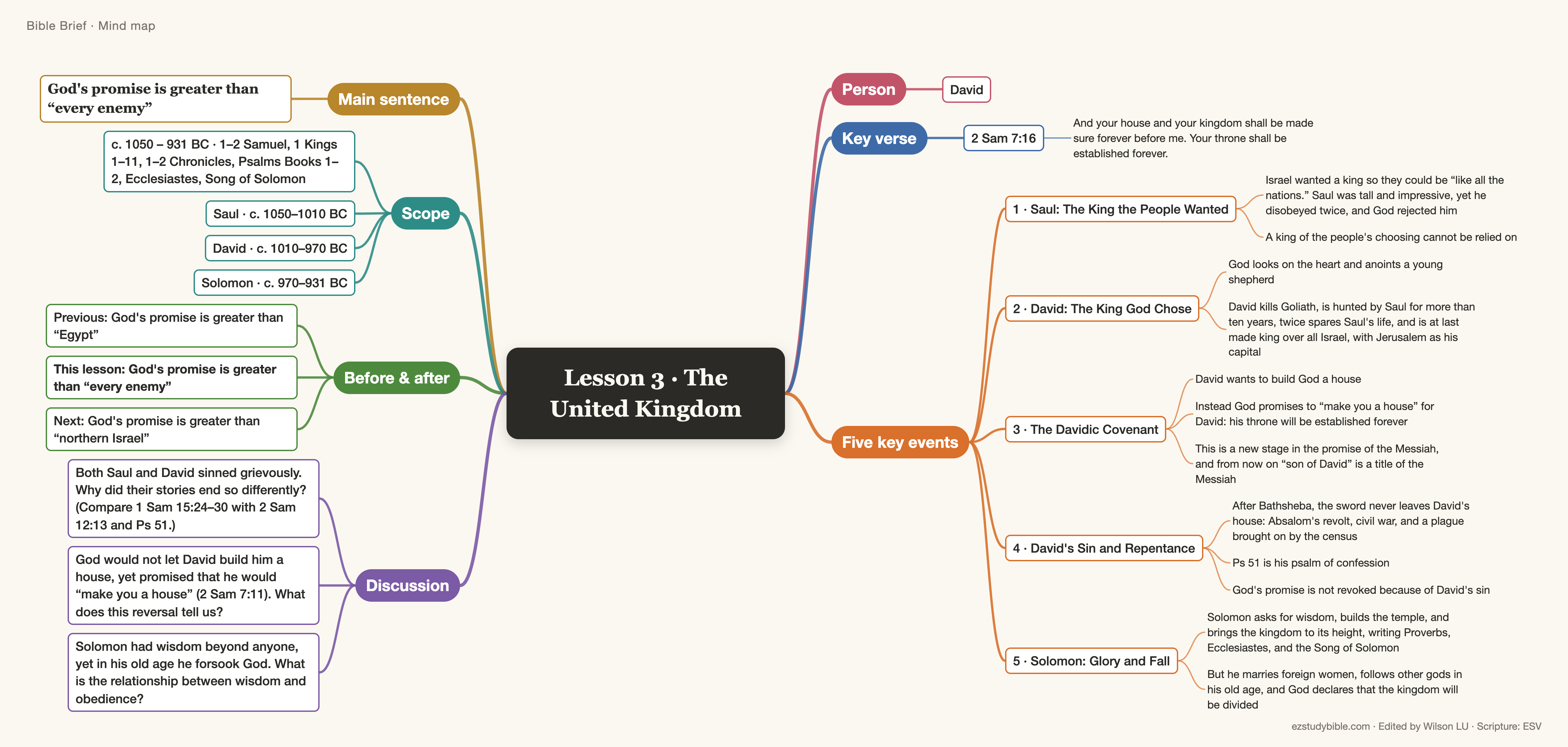
God's promise is greater than every enemy
- Person
- David
- Key verse
- And your house and your kingdom shall be made sure forever before me. Your throne shall be established forever.2 Sam 7:16
- Saul: The King the People Wanted
Israel wanted a king so they could be “like all the nations.” Saul was tall and impressive, yet he disobeyed twice, and God rejected him. A king of the people's choosing cannot be relied on.1 Sam 8-15
- David: The King God Chose
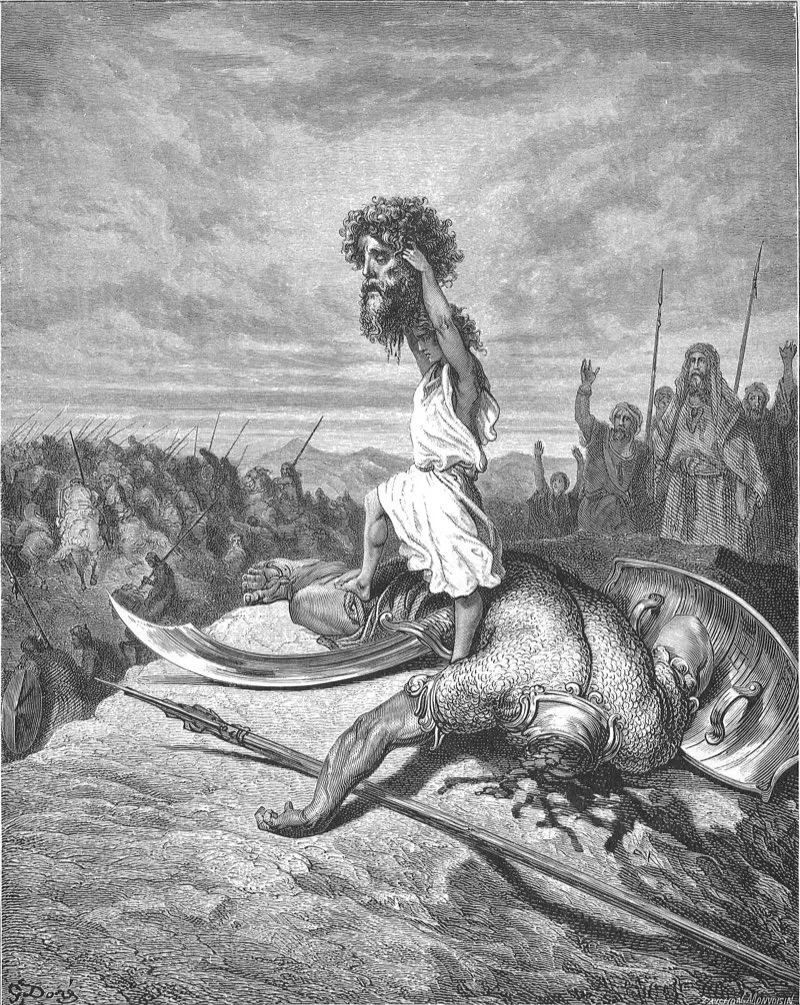
God looks on the heart and anoints a young shepherd. David kills Goliath, is hunted by Saul for more than ten years, twice spares Saul's life, and is at last made king over all Israel, with Jerusalem as his capital.1 Sam 16-312 Sam 1-5
- David's Sin and Repentance
After Bathsheba, the sword never leaves David's house: Absalom's revolt, civil war, and a plague brought on by the census. Ps 51 is his psalm of confession. God's promise is not revoked because of David's sin.2 Sam 11-24Ps 51
- Solomon: Glory and Fall
Solomon asks for wisdom, builds the temple, and brings the kingdom to its height, writing Proverbs, Ecclesiastes, and the Song of Solomon. But he marries foreign women, follows other gods in his old age, and God declares that the kingdom will be divided.1 Kgs 1-11
- Lesson 3: God's promise is greater than every enemy
- This lesson's person is David
- God promised David: your throne shall be established forever
Think first, then tap a blank to see the answer.
Group discussion
- Both Saul and David sinned grievously. Why did their stories end so differently? (Compare 1 Sam 15:24–30 with 2 Sam 12:13 and Ps 51.)
- God would not let David build him a house, yet promised that he would “make you a house” (2 Sam 7:11). What does this reversal tell us?
- Solomon had wisdom beyond anyone, yet in his old age he forsook God. What is the relationship between wisdom and obedience?
Reference notes for the discussion questions (church leaders)
…
Look up all points and notes 24 points
Saul
- 47
The people demand a king. Samuel anoints Saul, of the tribe of Benjamin, as Israel's first king.1 Sam 8-10
- 48
In his farewell address, the judge Samuel warns Israel not to forsake the LORD.1 Sam 12
- 49
Saul offers a sacrifice on his own authority, disobeying God's command, and Samuel declares that his kingdom will not continue. Abner serves as commander of Saul's army.1 Sam 13-14
- 50
God commands Saul to destroy the Amalekites completely. Saul does not obey, and God rejects him as king.1 Sam 15
David
- 51
God has Samuel secretly anoint David, a young man of Bethlehem from the tribe of Judah, as the next king. David kills the Philistine giant Goliath.1 Sam 16-18
- 52–53
Saul grows jealous of David and seeks to kill him. David flees, and his followers gather to him at the cave of Adullam.1 Sam 19-22
- 54–55
While Saul hunts him, David twice spares Saul's life. In the end he has no choice but to take refuge among the Philistines.1 Sam 23-27
- 56
The Philistines defeat Israel on Mount Gilboa. Saul and Jonathan fall in the battle.1 Sam 28-31
The original Brief cites 1 Sam 28–30; Saul's death is in 1 Sam 31. The original's phrase “while David was busy helping Israel” does not match the text (in 1 Sam 29 the Philistines send David home; in ch. 30 he pursues the Amalekites), so it has been removed. - 57
- 58–59
- 60
- 61
- 62
David sins: he takes Bathsheba and has Uriah killed. The prophet Nathan exposes his sin and foretells that the sword will never depart from his house.2 Sam 11-12
- 63
David repents, but his son Absalom stages a coup, and David flees Jerusalem. The civil war that follows costs 20,000 lives.2 Sam 13-19
- 64
Sheba leads the northern tribes in revolt; it is soon put down. The tragedies of David's later years are inseparable from his great sin.2 Sam 20-23
- 65
Psalms Book 1 (Pss 1–41)Mostly psalms of David. Ps 2: “You are my Son”; Ps 22: “My God, my God, why have you forsaken me?”; Ps 23: “The LORD is my shepherd.”Ps 1-41
The original Brief assigns the compiling of the five books of the Psalms to David, Solomon, Uzziah, Hezekiah, and Ezra, each with a date, adding “possibly”. Scholars have reached no consensus on how the five books were compiled, so this is kept here as one view. - 66
David takes a census of the people, bringing a plague that kills 70,000. He builds an altar on the threshing floor of Araunah, where the temple is later built.2 Sam 241 Chr 21-22
- 67
Adonijah tries to seize the throne. David makes Solomon king and charges him to keep God's Law.1 Kgs 1-21 Chr 22-29
Solomon
- 68
Solomon asks for wisdom, and God gives him wisdom, along with riches and honor. He spends seven years building the temple, and the glory of the LORD fills the house.1 Kgs 3-102 Chr 1-9
- 69
Psalms Book 2 (Pss 42–72)Psalms of the Sons of Korah, of Asaph, and of David. In Ps 51 David confesses his sin with Bathsheba; Ps 72 is a prayer for the king: “May he have dominion from sea to sea.”Ps 42-72
- 70
EcclesiastesThere is nothing new under the sun. For everything there is a season. Remember your Creator. The end of the matter; all has been heard. Fear God and keep his commandments, for this is the whole duty of man.Eccl 1-12
- 71
Song of SolomonThe Song of Songs. Love is strong as death; jealousy is fierce as the grave. Through the centuries it has often been read as a picture of the love between God and his people.Song 1-8
- 72
Solomon takes 700 wives and 300 concubines, many of them foreign women. They turn his heart after other gods, and in his old age he builds high places for them.1 Kgs 11
The original Brief cites 1 Kgs 9–12 and 2 Chr 7; the 700 wives and 300 concubines are in 1 Kgs 11:3. - 73
God declares that he will tear ten tribes from the hand of Solomon's son and give them to Jeroboam. After Solomon's death, Rehoboam succeeds him; his mother was an Ammonite.1 Kgs 11-122 Chr 9-10